

“Mom, look! There’s a dead crow!”
My ten-year-old pointed to the sidewalk across the way from the mailboxes in our condo complex. There was indeed a dead crow lying there, black feathers rustling in the breeze, looking like it had just tipped over for a nap. It must have just happened. I was wondering how the poor thing had met its end when I noticed my son creep closer to it.
“Don’t touch it!” I hollered.
He looked up instead, where several more crows were circling and cawing. “Mom, I think they’re having some sort of ceremony.”
He was right. The other crows were clearly engaged in some sort of funeral ritual, swooping and cawing, other crows showing up to join in.
Later, a quick Google search revealed that this is a common behavior for crows. The incessant cawing is an alarm call to alert other crows in the area that one of their own is down. Crows will actually engage in this funeral ritual whether they have blood ties or social bonds to the dead crow or not.1
Flirting with death
During the month of October, we in the United States are surrounded by reminders of death by way of spooky skeletons, fake headstones, and other decorations for Halloween. A few years ago, a friend of mine who had recently moved here from Brazil asked me about Halloween during a trip to a pumpkin patch with our children. I don’t understand, she said. What is this celebration for? What does it mean?
At the time, I was at a loss for words. Since then, I’ve learned that Halloween has its origins in the Celtic celebration of Samhain. Nowadays, it’s mostly about playing dress-up and getting candy—an excellent way to meet your neighbors, according to my pastor.
Christiana Peterson writes:
“Death is the most complex and mysterious of human experiences, and we are embedded in a culture that has misplaced the language and rituals to talk about such things.”2
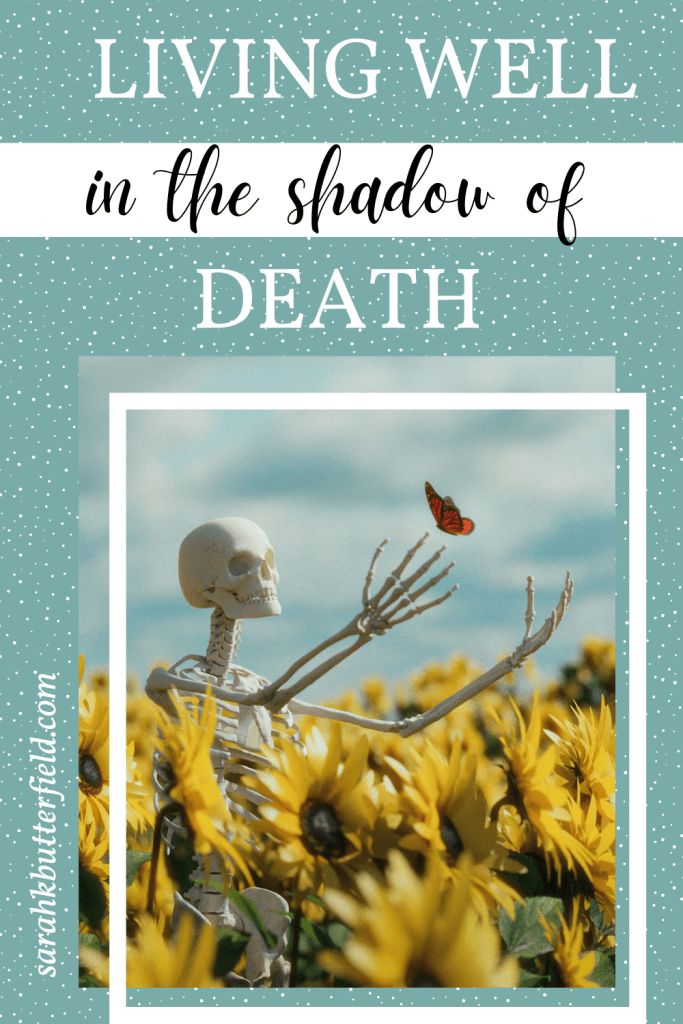
Beyond the sugar and costumes, I wonder if Halloween is a way we flirt with our own mortality and confront our unavoidable end. Maybe it’s a way we make light of the fact that we are nothing but blood and bones.
The end is not the end
As Christians, of course, we know that Death does not have the final say, that the resurrection power of Jesus means that we will live forever with him. This is the hope that meets us in our darkest times, that we cling to through every tragedy and trauma. In the meantime, though, our earthly bodies have an expiration date. We spend a lot of time and money pushing back the signs of our own decay as we grow older (this isn’t to say that I don’t own my fair share of fancy lotions and potions, I totally do).
But instead of fighting the inevitable, what if we fought to live well? Can we let the reality of our own mortality inform how we live and love today? Could facing our fear of death with the hope of Christ enable us to love others better?
Theologian N.T Wright reminds us:
“The point of the resurrection…is that the present bodily life is not valueless just because it will die…What you do with your body in the present matters because God has a great future in store for it…What you do in the present—by painting, preaching, singing, sewing, praying, teaching, building hospitals, digging wells, campaigning for justice, writing poems, caring for the needy, loving your neighbor as yourself—will last into God’s future.”3
Living an embodied faith starts with acknowledging that we are made of dust but made for heaven. This empowers us to value our present bodies as the means by which we worship and glorify God in our daily activities.
Liked this post? Please share it! And if you’re interested in growing in your faith as a busy woman, subscribe to get The Scoop, my twice a month newsletter filled with helpful links to the best posts and podcasts to encourage you in your journey of faith! As a thank you, you’ll get access to ALL my resources in the Free for You library: breath prayers, free e-books, and more!
- The Mourning Behaviors and Funeral Rituals of Animals ↩︎
- From Awakened by Death by Christiana N. Peterson, p. 5
↩︎ - From Surprised by Hope: Rethinking Heaven, the Resurrection, and the Mission of the Church by N.T. Wright ↩︎
This post first appeared on my Substack newsletter, The Scoop. Want more encouragement delivered straight to your inbox? When you subscribe, you’ll get The Scoop twice a month—packed with the best posts, podcast recommendations, and resources to help you grow your faith as a busy woman. Plus, as a thank-you, you’ll get instant access to my entire Freebie Library: breath prayers, free e-books, and more! Subscribe here.
 Sarah K. Butterfield