

It was the day after Thanksgiving, and we had just unboxed our tree. It sat bare in the living room while I went to the garage to fetch all the trimmings. My husband strung the lights and I set out the boxes of ornaments, marveling at all the colors and memories, but something felt off.
The Christmas music was playing. The fir-scented candle was lit. But something was missing. A quick look around the living room revealed that my boys were both engrossed in other activities.
Don’t you want to help hang the ornaments? I asked.
My eleven-year-old, nose in a book, told me to hang on.
My nine-year-old, busy coding in a kid-friendly computer program, said he’d come over in a minute.
So this is what was missing: the buoyant enthusiasm they usually have for decorating the tree. I had a pang of nostalgia for those early years, when my boys would squeal with glee and jump up and down with excitement. In the past, they wouldn’t dare let me touch an ornament without them!
This year, they did enjoy hanging ornaments but not with the same loud wonder and delight as when they were little. While this may be to be expected as kids grow older, I’ve noticed a similar pattern in myself when it comes to the biblical story of Christmas.
Jaded by Christmas
Sometimes I wonder if I’ve grown so familiar with the nativity story that the sheer miracle of it has ceased to sink in. Is it possible there’s no more room in my heart for the awe and wonder of the incarnation? Could it be that my biblical imagination has been tamped down by the predictability of it all?
Familiarity smothers wonder. We are so used to the decorations, to the fanfare, to the nativity story that there’s no breath taken away. It occurs to me that maybe our efforts to make the season magical is an attempt to recapture the sense of wonder that we’ve lost somewhere along the way.
A year or two ago, I came across a poem that had me smiling from ear to ear. It’s called “Sharon’s Prayer” by John Shea, and it tells the story of a five-year-old girl who recounts the Christmas story to some unnamed audience. She describes how poor Joseph and Mary were, only eating peanut butter and jelly sandwiches, and how there were sheep at the manger that you could pet but not feed. At the end of the poem, she announces with wide-eyed shock that the baby who was “borned” was GOD! And then she throws herself on the couch, which is “is the only proper response/to the Good News/of the Incarnation.”
I long to be the little girl who throws herself onto the sofa. I want to be re-captivated by the story of Christmas, to have my imagination reignited for just how incredible it is that “THE BABY WAS GOD!”
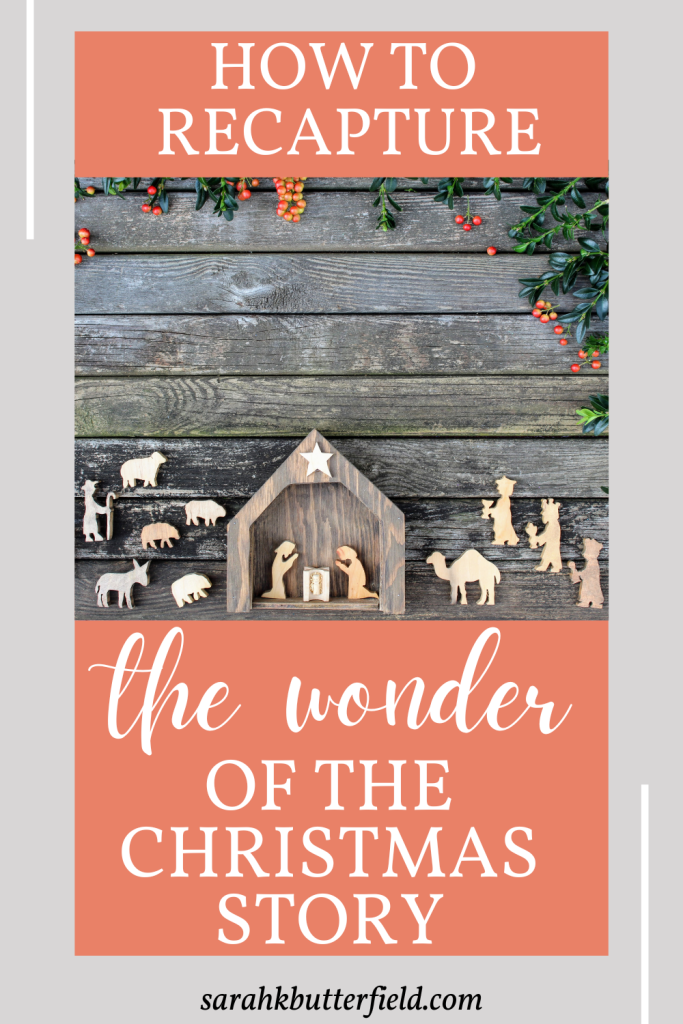
How can we recapture the wonder of Christmas?
I wish I had a foolproof formula to share with you today, but instead I only have some thoughts I’ve been mulling around. So, I humbly offer to you these suggestions:
1. Invite Jesus to speak to you
Let God know of your desire to draw closer to the miracle of the Incarnation this Advent season. Ask God to reveal Himself to you in new ways this month, that the Holy Spirit would help you see the Christmas story with fresh eyes.
Earlier this week, in one of my quiet morning moments, it occurred to me that I needed to pray this prayer. Later that same day, I was leading a Bible study, the kind that doesn’t require homework, just a reading of the Bible story and some thoughtful discussion questions. The text happened to be in Luke chapter 1, the story of Mary and Elizabeth. The study questions elicited some meaningful discussion, and this otherwise-familiar story came to light for me in a new way.
2. Engage your God-given imagination
When we hear the story of Christmas from the pews, or when we read it on our own, it’s easy to let familiar texts wash over us. But what if we intentionally and actively used our God-given gift of imagination? Narratives lend themselves well to this. We can put ourselves in the scene. Are we the main character? An onlooker? A bit player?
I once listened to an audio devotional that led me in this type of biblical imagination. I listened as they read the story of the Good Samaritan. The voice asked: “Which character do you see yourself as? Which one do you feel the most resonance and empathy for?”
My gut reaction surprised me: I was the priest in the story. At the time, I was working in a ministry role, so the priest’s response made sense to me—had he stopped, he would have been unclean and wouldn’t have been able to continue his work that day. Important work! Ministry work! Give the priest a break, I thought. This exact moment was when I realized I was experiencing burnout.
It’s worth engaging our imaginations as we read or hear about Jesus’ birth in the Bible. Picture the scene and notice what you experience.
3. Turn your attention to art
Just like the poem above, there is something about art that can draw our attention inward and upward. Modern protestant churches (both mainline and evangelical) typically don’t display icons, stained glass, statues, or mosaic art, but there is something about beauty that speaks to us on a deeper level and this is because God is the originator of all things beautiful.
We can ponder a piece of music, an illustration in a book, words arranged just so in a poem or story or essay, and be moved. Notice what stirs within you as you contemplate the art of the season and turn it in to a prayer. Respond to God about what you are experiencing, and note how God might be revealing Himself through art.
Some Advent-specific artwork I’ve enjoyed these last few years:
- Making Room for Advent, artwork and devotional by Bette Dickenson
- God Speaks Through Wombs, poems by Drew Jackson
- The Weary World Rejoices, playlist by Wycliffe Bible Translators
4. Carve out time for silence
This is maybe the best suggestion, but the hardest to implement. We like to joke that “All mama wants for Christmas is a silent night” but the larger truth is that all of us are “starved for quiet, to hear the sound of sheer silence that is the presence of God himself.”*
In this day and age, it takes a lot of self-discipline not to fill our ears with podcasts or music, and not to reach for a book or our phone the second we get some quiet space to ourselves. If we do take a few minutes to sit in silence, the things that come to mind are distracting at best and anxiety-provoking at worst.
It’s worth it to keep trying. Silence creates space for us to sit in Jesus’ presence, and it “offers a way of paying attention to the Spirit of God and what he brings to the surface of our souls.”** If we want to recapture the wonder of Christmas, simply sitting in silence for a few minutes a day would allow for more space and time for God’s Spirit to move in us.
May we all have a wonder-filled Advent and Christmas this year!
Liked this post? Please share it! And if you’re interested in growing in your faith as a busy woman, subscribe to get The Scoop, my twice a month newsletter filled with helpful links to the best posts and podcasts to encourage you in your journey of faith! As a thank you, you’ll get access to ALL my resources in the Free for You library: breath prayers, free e-books, and more!
*From Invitation to Solitude and Silence, by Ruth Haley Barton
**From Spiritual Disciplines Handbook, by Adele Ahlberg Calhoun
Feature Photo by Leon Oblak on Unsplash
 Sarah K. Butterfield